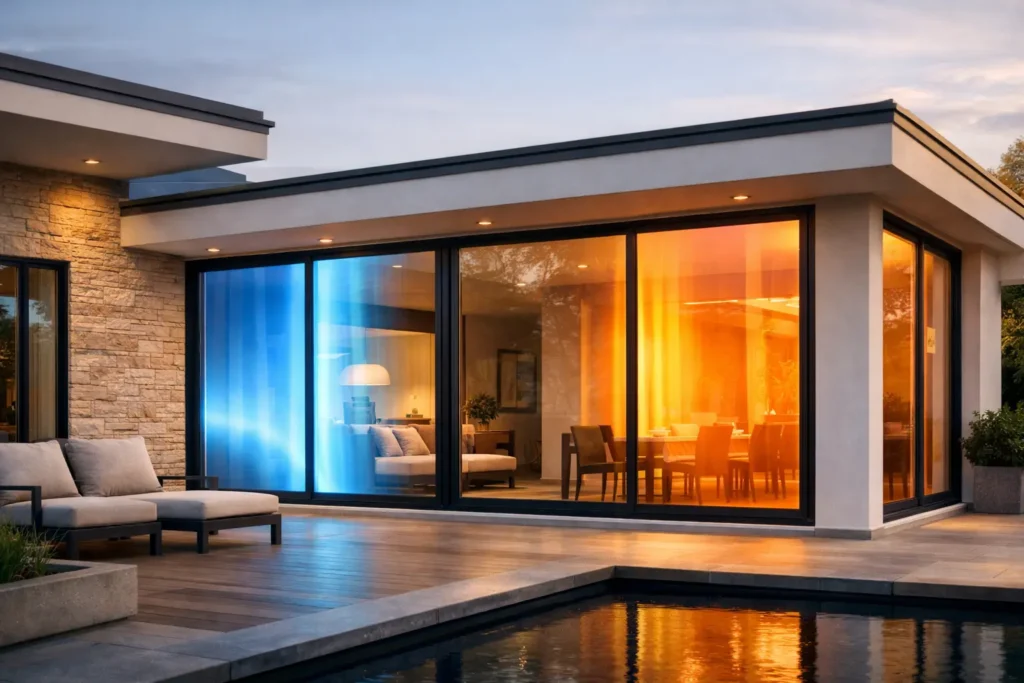
Understanding Window U-Values and Energy Ratings
kaye mori • January 13, 2026

January 13, 2026

window u-values

Window U values measure how well a window resists heat transfer. They directly affect how much energy your home uses for heating or cooling. This guide explains window u-values, how they work, and why they’re crucial when choosing energy-efficient windows. Understanding window u-values can help you make better choices for your home.

You’ll learn:

  • What window u-values are and how they’re calculated
  • The impact of window u-values on energy bills
  • How window u-values differ from Window Energy Ratings (WER)
  • Legal standards by country concerning window u-values
  • How to choose the best window u-value for your home

A light blue, semi-transparent ice cube shown from a high angle against a white background.What Are Window U Values?

Window U values indicate how much heat a window allows to pass through. The lower the U-value, the better the insulation. It’s a numerical expression of thermal transmittance, measured in watts per square meter Kelvin (W/m²K).

What Does a U-Value Measure?

  • Thermal transmittance : Measures how much heat flows through a material.
  • Heat flow resistance : Lower U-values mean better insulation.
  • Energy loss rate : Expresses how quickly indoor heat escapes to the outside.

Glazing Type

Typical U-Value (W/m²K)

Single glazing

5.0 – 6.0

Double glazing

1.2 – 2.8

Triple glazing

0.6 – 1.2

Quadruple glazing

0.3 – 0.5

Why are Window U Values Important?

  • Energy efficiency : U-values help define a window’s insulation value.
  • Building envelope performance : Affects the overall thermal integrity of your house.
  • Building compliance : Regulated by national and international energy standards.

Next: Learn how U-values impact your energy consumption and heating costs.

A stylized, light-beige money bag icon with a dark gray dollar sign on the front and a dark red tie at the top.Why Window U Values Matter in Energy Efficiency

Selecting windows with lower window u-values enhances the overall energy performance of your home. This is crucial not just for comfort but also for reducing your carbon footprint.

Lower U-values reduce heat loss, which lowers heating demand and energy bills. They also contribute to long-term sustainability by reducing your carbon footprint.

How Do U-Values Affect Heating Efficiency?

  • Heat loss prevention : Well-insulated windows slow down heat transfer.
  • Energy conservation : Homes retain warmth in winter and remain cooler in summer.
  • Comfort : Fewer cold spots and drafts near windows.

Energy Cost Impact

Windows with low U-values:

  • Reduce HVAC system workload
  • Lower annual energy bills by up to 20%
  • Help qualify homes for Energy Star and Passivhaus certifications

Example: Replacing old single-pane windows (U-value 5.0) with triple-glazed ones (U-value 0.8) can save £150–£300/year in heating costs in the UK.

Role in Sustainable Design

  • Passive solar gain : Helps store and use natural heat efficiently.
  • Carbon emissions : Lower U-values reduce greenhouse gas emissions.
  • Green building compliance : Required for BREEAM, LEED, and Passive House projects.

Next: Let’s compare U-values with other window energy performance metrics.

A bold white Understanding Window Energy Ratings vs U-Values

Window U values and Window Energy Ratings (WERs) are not the same. They measure different aspects of energy performance.

What’s the Difference?

Metric

U-Value

WER

Measures

Heat transfer

Overall energy efficiency

Unit

W/m²K

A+ to G scale (UK)

Includes

Only thermal transmittance

U-Value, solar gain, air leakage

Used by

Engineers, manufacturers

Consumers, installers, regulators

What Is WER?

  • Window Energy Rating (WER) is a composite score.
  • It includes U-Factor, Solar Gain (g-value), and Air Leakage.
  • The UK uses BFRC labels from A++ (best) to E (worst).


Example: A window can have a low U-Value but a lower WER if it doesn’t allow enough solar gain in colder climates.


When to Use Which?

  • Use U-Value when comparing thermal insulation.
  • Use WER for consumer-level comparisons of complete performance.
  • Builders often reference both for compliance and product selection.


Next: What’s considered a “good” U-value? See benchmarks for different window types.

A yellow ruler positioned diagonally with black tick marks along its edge.What Is a Good Window U-Value?

What Is a Good Window U Value

A good U-value for windows depends on climate, building type, and glazing technology. The lower the value, the better the insulation.

Recommended U-Values by Glazing Type

Window Type

Ideal U-Value (W/m²K)

Double glazing

≤ 1.6

Triple glazing

≤ 1.0

Passive House windows

≤ 0.8

Quadruple glazing

≤ 0.6

Factors That Influence U-Values

  • Glazing layers : More layers = lower U-Value
  • Low-emissivity coatings : Reflect heat back into the room
  • Argon-filled glass units : Reduce thermal conductivity
  • Frame material : uPVC and timber often insulate better than aluminum.
  • Thermal breaks & spacer bars : Minimize thermal bridging


Passive House certified windows typically achieve U-values below 0.8 W/m²K.

Choosing the Right U-Value

  • Cold climates: Triple glazing with U ≤ 0.8
  • Mild climates: Double glazing with U ≤ 1.4
  • High-performance homes: Passive House-standard windows
  • Renovations: Focus on the overall window unit, not just the glass pane.


Next: Discover how window U values are measured and certified.

A tilted glass test tube containing light green liquid with small bubbles.How to Measure and Check Window U Values

Window U values are calculated using lab tests or simulation models. Certified bodies and software tools ensure standardization.

How Are Window U Values Measured?

  • Laboratory testing : Performed using controlled heat sources, typically under ISO 10077.
  • Simulation modeling : Predicts U-values using energy modeling software like THERM or WUFI.
  • In-situ testing : Thermal cameras may detect performance discrepancies post-installation.


Tools and Certifications

  • U-Value calculators : Online tools from manufacturers or third parties
  • Energy modeling software : Assesses window performance in different climates
  • Certification bodies :
    • BFRC (UK)
    • NFRC (USA)
    • PHI (Passive House Institute)


How to Verify Window U Values

  • Check product documentation
  • Look for certification labels (Energy Star, BFRC, CE Marking)
  • Ask for the whole-window U-Value, not just the center-of-glass


Warning: Some suppliers list only the glass U-value, which ignores the impacts of the frame and spacer.

Next: What legal standards apply to window U values in different countries?

⚖Regulations and U-Values in Your Region
Regulations and U Values in Your Region

Each country has specific legal minimums for window U values in building codes. Failing to meet these can affect home resale, compliance, and energy audits.

Window U-Value Standards by Country

Country

Residential Max U-Value

Regulation

UK

1.4 W/m²K

Building Regulations Part L

USA

0.30 BTU/hr·ft²·°F (~1.70 W/m²K)

Energy Star / IECC

EU

1.0 – 1.3 W/m²K

EPBD (Energy Performance of Buildings Directive)

Canada

1.4 W/m²K

NRCan / Energy Star Canada

Australia

2.0 W/m²K or better

NCC Section J

How to Ensure Compliance

  • Choose certified suppliers listed in local databases
  • Request a compliance certificate with U-Value details
  • Verify documentation for new builds and renovations
  • Work with energy assessors or building inspectors

Next: Find quick answers to common window U-value questions.

FAQ – Common Questions About Window U Values

If you have any questions regarding window u values or their impact on your energy bills, feel free to reach out for expert guidance.

What’s a good window U-value?

A good U-value is ≤ 1.4 W/m²K for most homes. Passive House standards require ≤ 0.8 W/m²K.

Is a lower U-value better for windows?

Yes. Lower U-values mean better insulation and lower energy loss.

Do U-values affect energy bills?

Yes. Poor U-values lead to heat loss, increasing heating demand and energy costs.

What’s the difference between U-value and R-value?

  • U-Value : Measures heat transfer (lower is better)
  • R-Value : Measures resistance to heat flow (higher is better)

They are inversely related:
R = 1 / U

Can I upgrade old windows to improve U-value?

Yes. Options include:

  • Installing secondary glazing
  • Applying low-e window film
  • Replacing with double- or triple-glazed IGUs
  • Sealing frames and gaps to reduce air leakage

How are U-values calculated for different window types?

  • Double glazing : Center-of-glass + frame + spacer U-Values combined
  • Triple glazing : Adds another layer, reducing transmittance
  • Whole window simulations follow ISO 10077 for consistency

What’s the ideal U-value for my climate?

Climate Zone

Recommended U-Value

Cold (Canada, Scandinavia)

≤ 0.8 W/m²K

Temperate (UK, Germany)

≤ 1.2 W/m²K

Warm (Australia, South US)

≤ 1.6 W/m²K

Want More High-Quality Roofing Projects on Long Island?

G&V Roofing delivers trusted craftsmanship, reliable service, and local expertise that turns property owners into lifelong clients—all from one professional source.

Our Services:

A flat icon of a hammer with a gray metal head and an orange handle. Slate Roofing— Elegant, long-lasting, and perfect for upscale homes.
A classic grey icon of a bank building with a triangular pediment and three pillars. Tile Roofing— Durable and stylish roofing built to handle the Northeast climate.
A simple, flat-style illustration of a yellow, two-story house with a grey roof, blue windows, brown door, and red chimney. Residential Roofing— From repairs to full replacements, we protect your home like it’s our own.
A stylized, tan office building icon with a central tower, blue windows, and a dark grey base. Commercial Roofing— Professional-grade roofing systems for businesses and facilities.
A simple, light blue water droplet icon on a plain white background. Gutters— Proper drainage solutions to protect your foundation and landscaping.
A square window with a brown frame divided into four equal panes by a crossbar, showing a light blue reflection. Windows Energy-efficient and beautiful—enhance your view and lower utility bills.
A red rectangular brick with three cylindrical holes positioned in a row, shown from a high-angle isometric perspective. Siding— Boost curb appeal and protect your exterior with high-performance materials.

Learn About:

✅  Choosing the Right Roofing Materials for Long Island Homes
✅  Roofing Tips for Nassau & Suffolk County Weather
✅  How to Spot Roof Damage Before It Becomes Expensive
✅  The Real Cost of Delaying Roof Repairs
✅  Seasonal Roof Maintenance Checklists

A two-story yellow house with a gray roof, a red chimney, blue windows, and green trees on a green lawn.Looking to Upgrade Your Roof or Protect Your Property Investment?

Whether you’re a homeowner looking for reliable roof solutions or a property manager seeking fast, expert repairs—G&V Roofing is your go-to Long Island partner for long-lasting protection and peace of mind.

A red pushpin pointing downward at an angle.Follow Us for the Latest in Roofing Care, Property Protection & Home Improvement:

A light blue musical note icon. Tiktok : Watch fast transformations, tips from the crew, and roofing secrets revealed
A dark gray icon of a vintage-style motion picture camera. YouTube: Explore step-by-step guides, customer stories, and full project showcases
A stylized, dark gray camera icon with a blue circular lens and a large, yellow, eight-pointed flash starburst. Instagram: See beautiful before-and-afters, behind-the-scenes content, and premium materials
A yellow, cartoon-style thumbs-up icon representing approval or agreement. Facebook: Read reviews, see featured jobs, and connect with the local G&V Roofing community

A yellow hand icon with an extended index finger pointing to the right.Contact G&V Roofing today and discover why craftsmanship matters
By kaye mori January 14, 2026
What are house siding panels, and why are they important?House siding panels protect exterior walls from moisture, pests, and environmental exposure. They also boost curb appeal and improve a home’s energy efficiency through insulation and thermal resistance. Common House Siding Panel Types and Their Characteristics Siding Type Material Lifespan Maintenance Level Key Features Vinyl PVC-based […]
By kaye mori January 14, 2026
Learn how house siding prevents moisture damage by forming a durable barrier that safeguards your home’s structure, boosts energy efficiency, and supports healthier indoor air. How Does Moisture Affect Your Home’s Structure? Moisture infiltrates the building envelope and causes: Wood rot in structural framing Insulation saturation, reducing thermal performance Degradation of drywall and flooring materials […]
By kaye mori January 14, 2026
Preventative roof maintenance refers to the proactive approach of regularly inspecting and servicing commercial roofing systems to identify and fix minor issues before they escalate into costly problems. Unlike reactive repairs, which are performed after visible damage or leaks occur, preventative roofing maintenance is structured and scheduled and aims to preserve the roof system components […]
Show More →