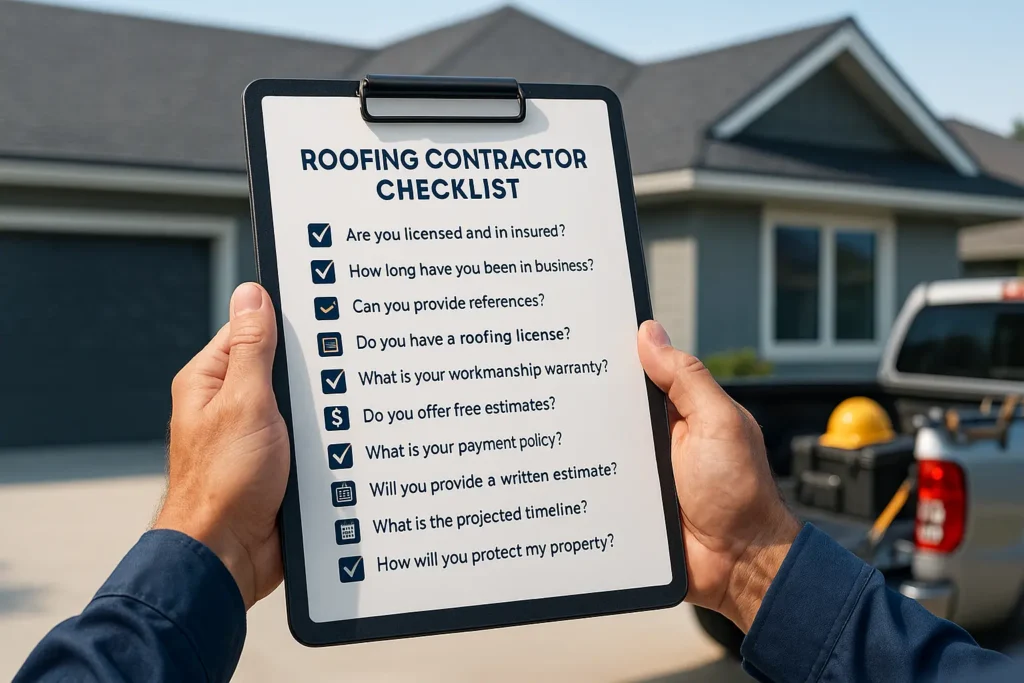
A licensed and insured roofer protects your property, finances, and safety. Without proper credentials, you risk legal liability and substandard work.
What licenses and insurance should a roofing contractor have?
- Valid Roofing License
- Issued by a state board or regulatory body
- Proof of passing required exams
- Verified contractor ID number
- Liability Insurance
- Covers property damage or onsite accidents
- Minimum coverage varies by state
- Worker’s Compensation Insurance
- Required if the contractor employs a crew
- Protects against injury lawsuits
How to verify roofer credentials:
- Request their license number and insurer details
- Check the license status via your state contractor board
- Ask for proof of coverage and policy expiration dates
 Tip:
Never hire uninsured roofing contractors—even if they offer a lower bid.
Tip:
Never hire uninsured roofing contractors—even if they offer a lower bid.
Next, look at their work history and project experience.
Experience predicts reliability. A contractor’s track record, completed jobs, and homeowner feedback indicate the quality you can expect.
Key points to evaluate:
- Years in business : Aim for at least 5–10 years of operation
- Project gallery : Ask for a site or portfolio with photos
- Local references : Request contacts from nearby completed jobs
- Review platforms : Check Google, Yelp, BBB, and Angi
- Roofer reputation
: Look for repeat clients or referrals
 Ask:
“Can you show me at least three local roofing projects you’ve completed?”
Ask:
“Can you show me at least three local roofing projects you’ve completed?”
Next, ask for a written roofing estimate and a clear scope of work.
A legitimate roofing contractor provides a detailed written quote. This protects both parties and allows you to compare offers clearly.
Your written estimate should include:
| Section |
Details Required |
| Materials |
Shingle type, underlayment, drip edge |
| Labor Costs |
Number of days, crew size, hourly rate |
| Tear-Off & Disposal |
Dumpster fees, debris cleanup |
| Timeline |
Start date, duration, weather buffer |
| Warranty Info |
Material and workmanship coverage |
| Total Cost |
Full project bid, with breakdown |
Red Flag:
Vague or verbal-only estimates may indicate poor reliability or hidden charges.
Next, check what warranties are included in your roofing project.
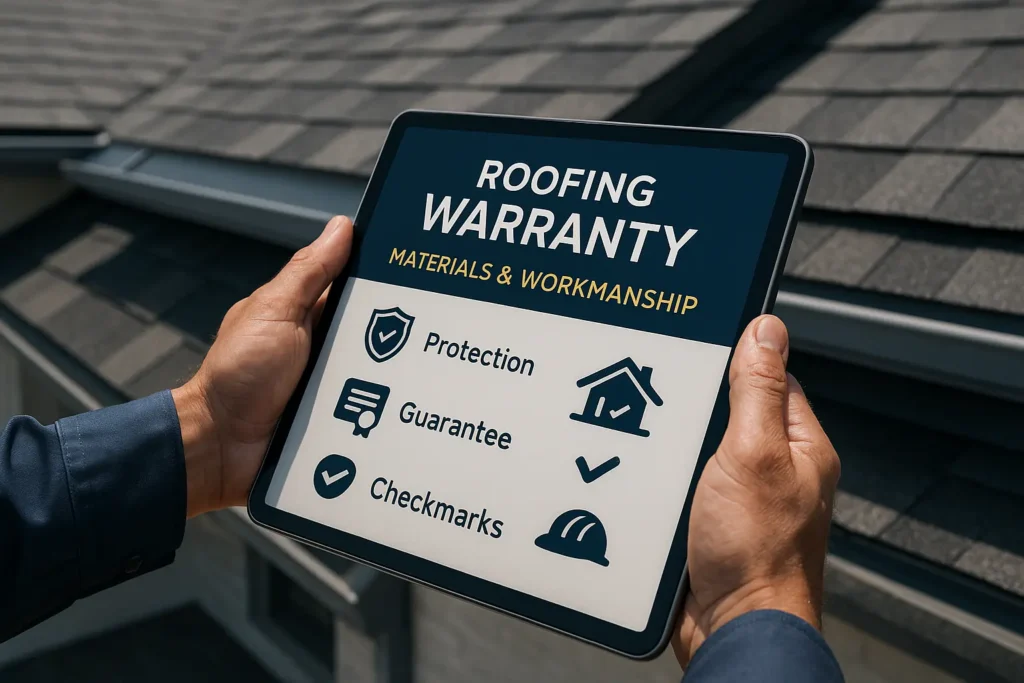
Warranties protect your investment. Professional contractors provide both manufacturer warranties and workmanship guarantees.
Two types of roofing warranties:
- Material Warranty (Manufacturer)
- Covers defects in roofing materials
- Often 20–50 years depending on the brand
- Requires certified installer (e.g., GAF Master Elite)
- Workmanship Warranty (Contractor)
- Covers installation errors
- Typically lasts 1–10 years
- Contractor must handle repair requests promptly
Ask if the warranty is transferable and what voids it.
Next, find out how they manage unexpected repairs or price increases.
Hidden roof damage can escalate costs. Your roofer should have a clear process for managing change orders and surprises.
Common unforeseen issues:
- Rotten roof decking
- Flashing damage or rust
- Mold from hidden leaks
- Code violations requiring updates
Ask about:
- Contingency budgets (5–15% recommended)
- Updated quotes before proceeding
- Photo documentation of new damage
- Written change order agreements
Tip:
Good roofers alert you before extra charges appear.
Next, understand the full roof installation process.
A reliable roofer explains each phase of the project and how they’ll handle disruptions.
Typical installation steps:
- Tear-off of existing roof
- Inspection of the roof deck
- Underlayment Installation
- Flashing and Ventilation setup
- Shingle or material installation
- Debris removal and site cleanup
- Final inspection and warranty activation
Ask these questions:
- “How long will each phase take?”
- “What happens if it rains during the install?”
- “Who inspects the final work?”
Request a day-by-day timeline and installation checklist.
Next, find out who’s actually doing the work: subcontractors or in-house crews.
In-house crews provide better control. Subcontractors can vary in quality and accountability.
Differences to clarify:
| Category |
In-House Crews |
Subcontractors |
| Supervision |
Company-employed foreman |
May work unsupervised |
| Insurance |
Covered under roofer’s policy |
Must carry own insurance |
| Quality |
Consistent across jobs |
Varies based on crew |
| Risk |
Lower |
Higher (less oversight) |
Ask if the crew will be background-checked, licensed, and trained by the company.
Next, examine how they maintain safety and cleanliness during the job.
A safe, clean job site prevents injuries and protects your property from damage.
Look for:
- Daily cleanup routines
- Trash disposal and dumpster usage
- Magnet sweep for nails and metal debris
- Protective tarps over gardens or driveways
- Compliance with OSHA safety standards
Ask questions like:
- “Will there be a supervisor onsite each day?”
- “Do you use fall protection equipment?”
- “How do you handle rain or storm delays?”
Some roofers charge a separate debris disposal fee, clarify this up front.
Next, learn how to identify contractors that go beyond basic service.

The best roofing contractors combine professionalism, premium materials, and proven credentials.
Signs of high-quality roofers:
- GAF or Owens Corning Certification
- BBB A+ Rating
- Consistent 5-star reviews
- Top-rated on local directories
- Warranty-backed workmanship
- High-end shingle options and ventilation upgrades
Ask about:
- Local awards or recognition
- Premium material partnerships
- Dedicated customer service or warranty reps
Top-rated contractors usually don’t offer the lowest price, but they deliver the highest value.
Next, review key FAQs that people often ask when hiring roofers.
Use this checklist to ensure you’re making the right hiring decision:
 Verify valid roofing license and insurance
Review past projects and local references
Get a detailed, written estimate with line items
Confirm material and workmanship warranties
Ask how they manage hidden repairs
Understand the step-by-step installation plan
Know who’s doing the work (in-house or subcontractors)
Clarify safety and cleanup procedures
Check certifications, reviews, and service quality
Compare 3 or more contractor bids
 Pro Tip:
Save or print this checklist as a vetting tool before signing a contract.
Pro Tip:
Save or print this checklist as a vetting tool before signing a contract.
G&V Roofing delivers trusted craftsmanship, reliable service, and local expertise that turns property owners into lifelong clients—all from one professional source.
Our Services:
 Slate Roofing—
Elegant, long-lasting, and perfect for upscale homes.
Slate Roofing—
Elegant, long-lasting, and perfect for upscale homes. Tile Roofing—
Durable and stylish roofing built to handle the Northeast climate.
Tile Roofing—
Durable and stylish roofing built to handle the Northeast climate. Residential Roofing—
From repairs to full replacements, we protect your home like it’s our own.
Residential Roofing—
From repairs to full replacements, we protect your home like it’s our own. Commercial Roofing—
Professional-grade roofing systems for businesses and facilities.
Commercial Roofing—
Professional-grade roofing systems for businesses and facilities. Gutters—
Proper drainage solutions to protect your foundation and landscaping.
Gutters—
Proper drainage solutions to protect your foundation and landscaping. Windows
—
Energy-efficient and beautiful—enhance your view and lower utility bills.
Windows
—
Energy-efficient and beautiful—enhance your view and lower utility bills. Siding—
Boost curb appeal and protect your exterior with high-performance materials.
Siding—
Boost curb appeal and protect your exterior with high-performance materials.
Learn About:
 Choosing the Right Roofing Materials for Long Island Homes
Roofing Tips for Nassau & Suffolk County Weather
How to Spot Roof Damage Before It Becomes Expensive
The Real Cost of Delaying Roof Repairs
Seasonal Roof Maintenance Checklists
 Looking to Upgrade Your Roof or Protect Your Property Investment?
Whether you’re a homeowner looking for reliable roof solutions or a property manager seeking fast, expert repairs—G&V Roofing is your go-to Long Island partner for long-lasting protection and peace of mind.
 Follow Us for the Latest in Roofing Care, Property Protection & Home Improvement:
 Tiktok:
Watch fast transformations, tips from the crew, and roofing secrets revealed
Tiktok:
Watch fast transformations, tips from the crew, and roofing secrets revealed YouTube:
Explore step-by-step guides, customer stories, and full project showcases
YouTube:
Explore step-by-step guides, customer stories, and full project showcases Instagram:
See beautiful before-and-afters, behind-the-scenes content, and premium materials
Instagram:
See beautiful before-and-afters, behind-the-scenes content, and premium materials Facebook:
Read reviews, see featured jobs, and connect with the local G&V Roofing community
Facebook:
Read reviews, see featured jobs, and connect with the local G&V Roofing community
 Contact G&V Roofing
today and discover why craftsmanship matters
Contact G&V Roofing
today and discover why craftsmanship matters